
Introduction
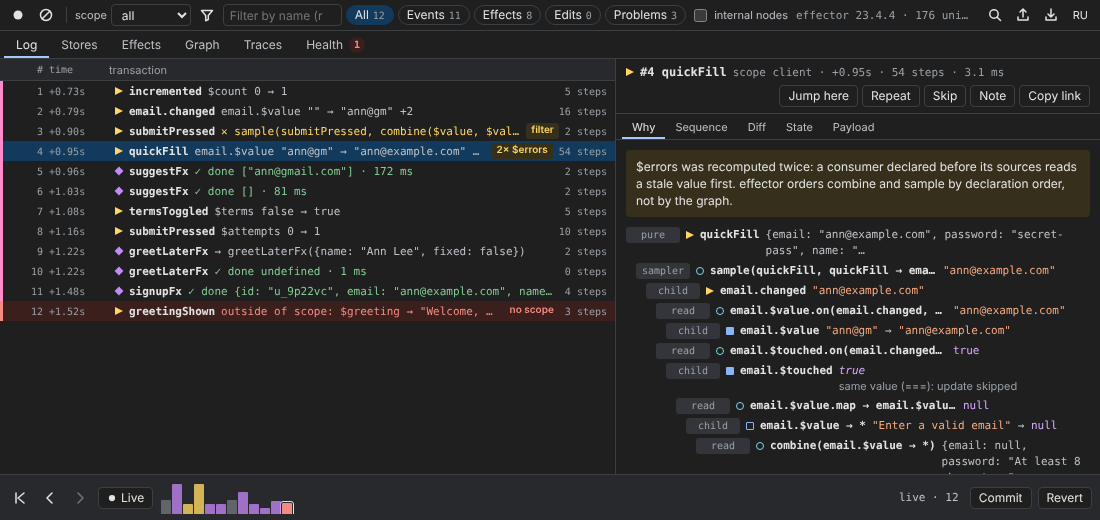
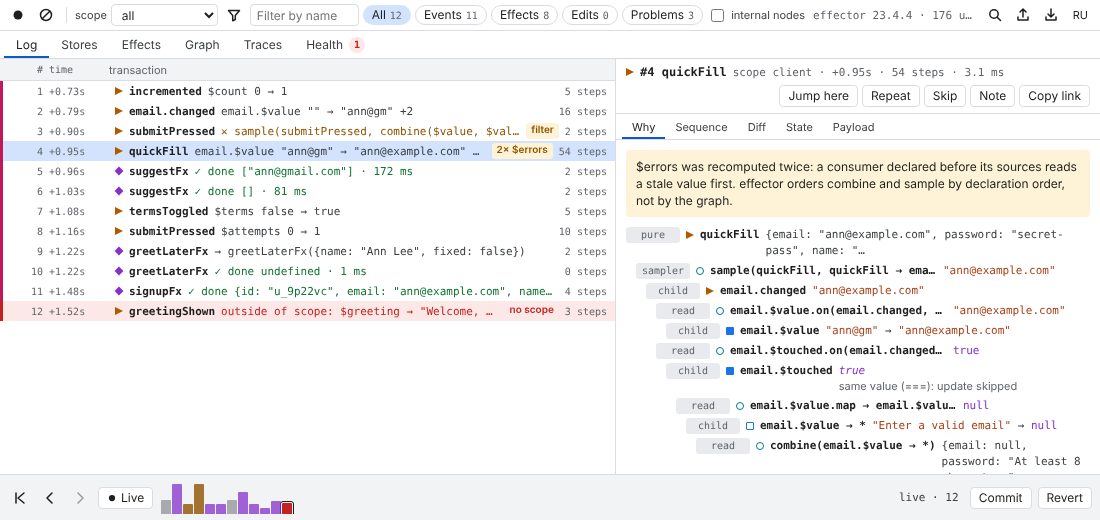
deffector is a DevTools for effector. It shows every user action as one transaction — an event and everything it caused — lets you travel through them, put your own state into any store, and record traces that another developer replays to reproduce your bug, like the Elm debugger.
Why
effector is fast and declarative, and the same properties make some bugs hard to see:
- an event called from
setTimeoutor a socket withoutscopeBindchanges the global graph, while the app reads its own scope — nothing happens on screen; combineandsamplerun in declaration order, not in graph order, so a store can be recomputed twice or asamplecan read a value that is about to change;- a
filterthat returnedfalseleaves no trace at all; - an exception in a
.mapstops one branch, the other branches have already committed; - a bug that needs twenty clicks and a slow server response is hard to hand over to a teammate.
deffector records what the kernel actually did and explains it in the panel: the Log shows the steps, Health turns the known pitfalls into warnings with a fix, Traces make the bug reproducible.
How it works
The agent (@deffector/agent) runs inside your page. It must be the first import, so that it sees units as they are created. It hooks effector’s kernel inspector and graph inspector — setInspector and setGraphInspector, the runtime exports effector/inspect is built on. They give the raw graph nodes, the exact parent of every step and the scope of every call, in all scopes at once:
- every unit is registered with its name,
sid, source file, factory, domain and model; - every kernel step is grouped into the transaction it belongs to, with the lane, the value before and after, and the reason it stopped (a filter, the same value, an exception);
- changes of writable stores are kept per transaction, so the state of any past moment can be rebuilt;
- commands from the panel — jump, edit, call, override, replay — are executed in the page.
The adapter (DeffectorProvider for React and Solid, withDeffector / DeffectorScope for Vue) is a drop-in replacement for effector’s own Provider. It registers the scope under a readable name and gives the agent a way to render the app with another scope: a forked copy of the past for time travel, or a fresh scope for replaying a trace.
The panel is one React UI, used in two places:
- the browser extension (Chrome, Edge, Firefox) — the agent talks to a content script with
window.postMessage, the content script to the background worker, the background to the DevTools panel. The content script opens its port only when the page has an agent, so ordinary pages cost nothing; - the standalone app (
npx @deffector/standalone) — for code outside a browser tab: SSR servers, Node scripts, tests, React Native. Agents connect over a WebSocket to/agent, panels in any browser tab connect to/panel.
In production builds every entry point of @deffector/agent resolves to a no-op through the production export condition, so the import can stay in your code.
Words used in these docs
| Term | Meaning |
|---|---|
| Transaction | One root call (a UI event, a timer, a settled effect, an edit from the panel) and every kernel step it caused synchronously. |
| Step | One node the kernel ran: a store update, an operator (sample, map, on…), an effect call. |
| Lane | The kernel priority the step ran in: pure, read, child, barrier, sampler, effect. |
| Scope | A fork() of the app state. global means the global graph (no scope). |
| Branch | A scope deffector created: a forked past after a jump, a scope with silent edits, or a replay. Marked with ⑂ in the scope selector. |
| Trace | A JSON file (deffector-trace@1) with the initial state, the external calls and the effect results of one scope — enough to replay the same story. |
Status
deffector is at version 0.1 and under active development. The changes it would like to see in effector itself are listed in Upstream effector PRs; until they are merged, deffector works on workarounds.