
Traces
A trace is a JSON file with everything needed to replay what happened in one scope: the state before the first step, every external call, and every effect result. You record a bug, send the file, and a teammate replays it in their own build — effects answer from the recording, no twenty clicks — like the Elm debugger.
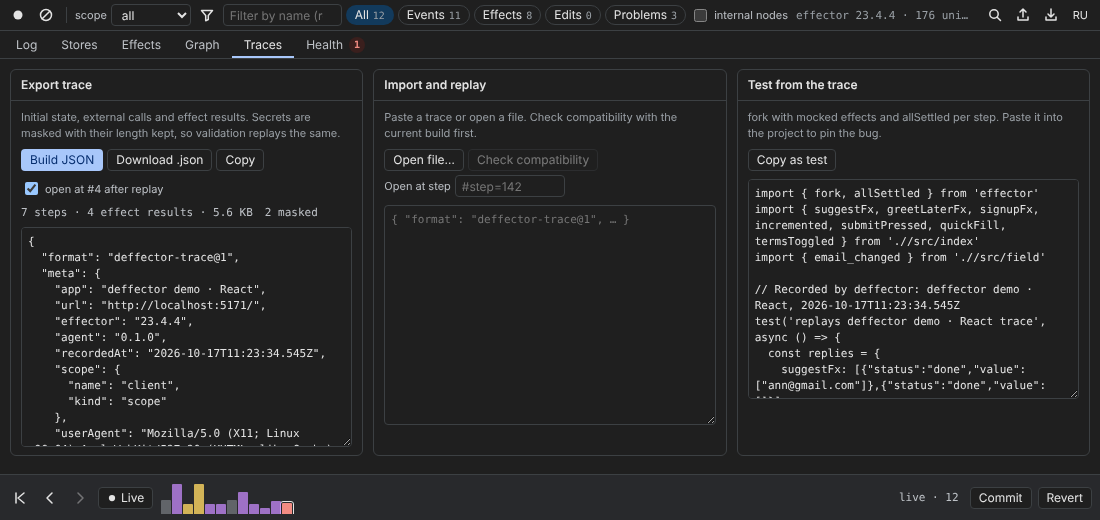
Export
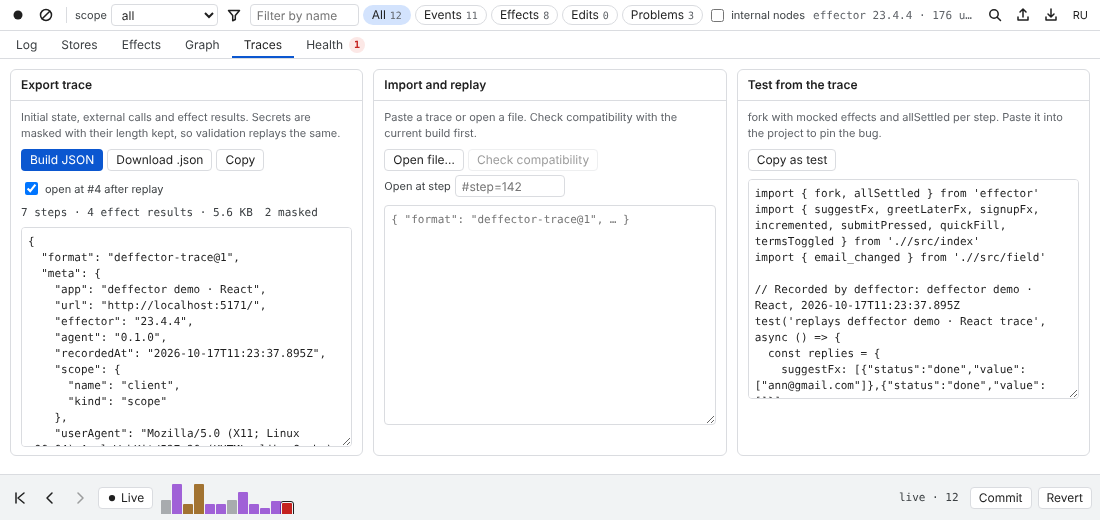
Export trace → Build JSON (or Ctrl+S anywhere, or the export button in the toolbar). Then Download .json or Copy. The line under the buttons sums it up: 7 steps · 4 effect results · 5.6 KB · 2 masked.
The trace is taken from the live scope and contains:
| Part | Content |
|---|---|
format | deffector-trace@1 |
meta | app name, URL, build, effector and agent versions, time, scope, user agent; focus — the step to open after replay |
units | every unit the trace refers to: name, kind, sid, file |
initial | values of writable stores before the first step |
steps | the external calls — events from the UI, timers and so on — with their params; edits from the panel are steps too, so they replay as well |
effectResults | what each effect call returned or threw, in call order, with its duration |
notes | the notes you attached |
redacted | paths that were masked |
lossy | values that cannot be restored exactly (functions, DOM nodes, class instances) |
Secrets are masked with their length kept. Values under keys that look like secrets — password, passwd, secret, token, authorization, cookie, api_key / apiKey, cvv, card (case-insensitive, also as part of a longer key) — and string values of stores whose name matches are replaced with • of the same length. Validation that checks length replays the same way.
With a transaction selected, the checkbox open at #N after replay writes it into meta.focus.
Import and replay
Paste a trace into the text field or Open file…, then Check compatibility. deffector matches the units of the trace to the units of the running app:
- by
sidfirst; - if the sid moved (code edited, another build), by name, kind and file — reported as a warning;
- units it cannot find are errors, and steps that call them will be skipped.
The report also says if the trace comes from another build (build option) or another effector version, what was masked, how many values are lossy and how many notes the author left.
Then:
- Replay in a new scope — deffector creates a fresh scope from the trace's initial state, mocks effect handlers with the recorded results, and replays the steps one by one, so you can watch them arrive in the Log. A banner reads “Replaying …: step 3 of 7 — effect results come from the recording, the network is not touched”. When it is done, the new scope becomes the live one.
- Apply instantly — the same without the pauses; the banner then says “Trace … applied”.
In global mode (no fork()) the replay writes the initial state in place and swaps effect handlers globally for its duration.
Open at a step
Open at step takes #step=142 (or just the number). After the replay, deffector jumps to the transaction that corresponds to step 142 of the recording. A #step=N pasted after the JSON in the import field works the same, and a trace with meta.focus opens there by itself. If the step is not in the replay, a message says so.
Test from the trace
Copy as test gives a vitest/jest test that reproduces the trace without the panel:
import { fork, allSettled } from 'effector';
import { suggestFx, incremented, quickFill } from './/src/index';
import { email_changed } from './/src/field';

// Recorded by deffector: deffector demo · React, 2026-10-17T11:23:34.545Z
test('replays deffector demo · React trace', async () => {
  const replies = {
    suggestFx: [
      { status: 'done', value: ['ann@gmail.com'] },
      { status: 'done', value: [] },
    ],
  };
  const reply = (list: { status: string; value: unknown }[]) => () => {
    const r = list.shift()!;
    return r.status === 'done' ? Promise.resolve(r.value) : Promise.reject(r.value);
  };
  const scope = fork({
    handlers: [[suggestFx, reply(replies.suggestFx)]],
  });
  await allSettled(incremented, { scope });
  await allSettled(email_changed, { scope, params: 'ann@gm' });
  // the password check is wrong here
  await allSettled(quickFill, { scope });
  // expect(scope.getState($store)).toEqual(...)
});
It is a starting point (abridged above): imports are derived from the source files of the units and unit names become identifiers (email.changed → email_changed), so adjust them to your exports; non-empty initial values go into fork({ values }), recorded effect results into fork({ handlers }), every step becomes an allSettled, and your notes become comments. Add the expect that pins the bug.
What travels and what does not
A trace replays inputs, not outputs: the steps are re-run by the kernel of the receiving build, so a fixed bug really does not reproduce, and a changed model shows its new behaviour. Effects that were called in the recording get the recorded results, in order; an effect the recording never called (because the code changed) runs its real handler. What a trace cannot carry: values listed in lossy, and calls to units that the receiving build does not have.
Traces from the demos are interchangeable: the model is compiled with the babel plugin, so sids are the same, and a trace recorded in React replays in Vue, Solid or Next.js.